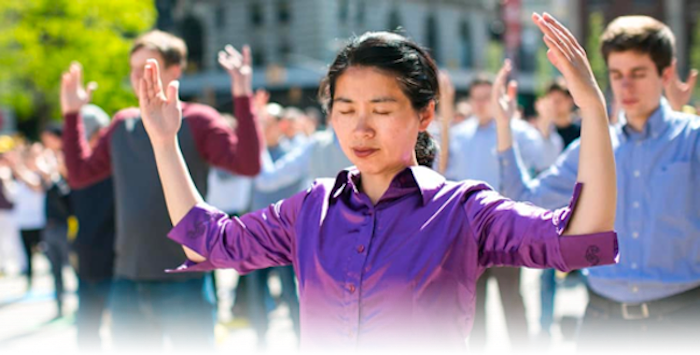

(Minghui.org) I am a teacher, and ever since I began practicing Falun Dafa, I have been guiding my students to become better people based on the principles that Dafa teaches—Truthfulness, Compassion, and Forbearance. By applying these principles to everything I do, I have found that all conflicts are easily resolved.
Sent to a Far Away School
On July 20, 1999, the Chinese Communist Party began the persecution of Falun Dafa practitioners. To prevent me from practicing Dafa, I was transferred from a school in my hometown to teach at another rural elementary school more than 20 miles away. At that time, I didn’t know how to ride a bicycle, so my family initially transported me to and from work every day by motorcycle.
I realized that, in the long run, this wasn’t a sustainable solution. Even though I was already in my 40s, I decided to learn how to ride a bicycle. During the learning process, I lost count of how many times I fell. Every time I fell, I got back up and kept riding.
Sometimes the chain would come off, sometimes a pedal would break, and sometimes the handlebars would bend, so I’d just push the bike along until I reached school and asked a colleague for help. Throughout the entire process, I practiced “endurance” and maintained a completely clear and open heart. Soon I was able to ride my bicycle to work.
Assigned to a Difficult Class
At my new school, the administration assigned me to the most challenging class. I later learned from a colleague that this group had already cycled through three homeroom teachers in just one semester. The students’ academic performance was poor; their conduct was even worse, and fights among classmates were rampant, with incidents breaking out every day. Parents frequently came to the school to cause a scene.
On my very first day on the job, four or five parents came to the school to see me and asked, “Can you really handle these kids?” I replied, “What’s there that I can’t teach?” They then explained some of the issues in the class to me. There were two children in the class with epilepsy; because of their condition, they would have seizures whenever they got emotionally agitated, so no one dared to speak up, and none of the teachers who had taught them before dared to discipline them.
These two children had developed the bad habit of bullying others, randomly picking on the girls in the class. They would take whatever they wanted from others, and if someone refused, they would snatch it. No one dared to say a word, for everyone was terrified of being held liable.
Resolved the First Major Challenge With Master’s Blessing
I had only been on duty for a few days when the two of them tried to take a ruler from a girl. When she refused to give it to them, they forcibly snatched it and even hit her. The girl, upset and in tears, said she wanted to go home and tell her parents.
After understanding the situation, I reprimanded the two students. Throughout the entire process, I acted in accordance with the principles of “Truthfulness, Compassion, and Forbearance.” I didn’t lose my temper; I calmly reasoned with the two students and taught them how to be good people.
The two children began to cry, and they actually had a physical reaction; their hands and arms started to twitch. The other students said, “Teacher, just leave it alone. If you keep talking, their parents will come looking for you to cause trouble. What will you do then?” At that moment, I thought: It is my responsibility to correct and educate children when they do wrong. If I ignore it and let them continue like this, these two children will be ruined, and that would be a dereliction of my duty.
With that in mind, I asked Master to empower me, and I knew these two children would be all right. Then I said to them, “As long as you listen to your teacher, stop bullying your classmates, and behave yourselves, you’ll be just fine.” I stretched their arms and rubbed their hands, and they really did get better.
I spent two class periods sharing stories with the class about how great figures throughout history, both ancient and modern, succeeded by striving to be good people. Subsequently, the two students recognized their mistake and apologized to the girl; the conflict was resolved, and harmony was restored among the students.
Teaching by Words and Deeds
To manage this class effectively, I made a promise to my students: I would arrive at school 30 minutes early every day to attend morning study hall with them, spend recess playing with them, and show genuine care for each student.
I always keep my word and never deceive my students. When the weather is bad, especially during heavy snowfall when I can’t ride my bike, I leave home over an hour early to arrive at school on time and attend morning study hall with my students.
Once, the snow was knee-deep. I hopped and slid my way down the mountain path, falling many times before finally reaching school. My pants and shoes were completely soaked. I was three minutes late for our scheduled time. I apologized to the students, saying, “I’m sorry, everyone, I’m late.”
To my surprise, more than half the class had tears in their eyes as they said, “Teacher, it’s okay.” Another student stood up and said, “Teacher, are you being silly? Not a single teacher in the whole school showed up—how can you say you’re late?” I replied, “According to our agreed-upon time, even one minute late counts as being late. How can I say I’m not late when I’m three minutes behind?”
Taking this opportunity, I told my classmates, “To be a good person, you must first be honest and trustworthy. No matter what happens, you must never break your promises; you must always follow through on what you say.”
From then on, the students and I shared an exceptionally close bond. In less than half a semester of teaching this class, the classroom atmosphere has undergone a complete transformation. The students’ grades have improved, fighting and name-calling have stopped, and everyone in the class now takes the initiative to do good deeds. Whether they’ve done something wrong at home or at school, they’re quick to come to me and admit their mistakes.
Dafa Guided Me and Blessed My Students
I’ve been teaching this class for two years, and during that time, there have been many acts of kindness and good deeds. My class is responsible for cleaning a designated area, and by the end of the term, I didn’t even need to assign specific students to duty; they took the initiative to clean on their own. Whenever they see trash, any student will step up to pick it up.
The students in my class are frequently commended by school administrators, and the principal even uses them as examples during faculty meetings. He often says, “There are no students who cannot be educated; it all depends on how the teacher guides them.”
My class was named an “Outstanding Class,” and I was recognized as a “Model Homeroom Teacher.” Even more amazingly, the two students who had epilepsy no longer had severe seizures.
Falun Dafa has bestowed upon me both wisdom and courage. I resolve to strive to do the three things well, to fulfill my vows, and to follow Master home to achieve consummation.
Articles in which cultivators share their understandings typically reflect an individual's perception at a point in time based on their cultivation state, and they are offered in the spirit of enabling mutual elevation.
Copyright © 1999-2026 Minghui.org. All rights reserved.
Category: Cultivation Insights