
(Minghui.org) Greetings, Master! Greetings, fellow practitioners!
In 2018, I joined the drum team of the Tian Guo Marching Band. After nearly 20 years of cultivation, and by conducting myself according to the principles of Truthfulness, Compassion, and Forbearance in daily life and work, I have generally been able to handle my relationships with people well, so conflicts and disputes have been rare. I enjoy participating in the band’s activities. Being together with fellow practitioners provides an excellent opportunity for cultivation and self-improvement.
Bearing Physical Suffering
When I first began participating in activities with the Tian Guo Marching Band, I found it quite challenging. During parades, I needed to concentrate fully on playing the music. But parading on the street also requires watching the conductor, paying attention to the road and other obstacles, and noticing pedestrians’ reactions. With so many external factors affecting me, I found it difficult to keep my mind completely focused, so I had to keep reminding myself to concentrate on the performance.
Occasionally, after marching for a time, I gradually started to feel the weight of the drum frame pressing painfully on both shoulders, especially the left one. At times, the pain was so intense that it even restricted the movement of my left arm. I then recalled Master’s poem:
“…A hundred hardships falling all at once,See how one lives....” (“Tempering One’s Heart and Will,” Hong Yin)
I thought to myself: “This is just a bit of physical pain, not yet “...A hundred hardships...” It would pass in a few days, so it’s nothing to worry about.” Indeed, by the next morning, the pain was usually almost gone and did not affect my participation in the following day’s parade. Enduring physical suffering is, in fact, also a process of eliminating karma.
The following year, after the parade, my shoulders would ache for about a week. After the final performance of that year, the pain lingered for a long time and did not go away. When my left arm was in certain positions, I would feel pain in my shoulder. This condition lasted for nearly a year. At first, I wasn’t too concerned, but as time went on, I began to feel uneasy and wondered whether this state was normal.
I shared my situation with a fellow practitioner, mentioning that this process of physical karma elimination had been going on for quite some time. She told me that she had already passed through that stage. I was surprised and asked what stage she meant.
She explained that during the early years, before the Marching Band activities, various kinds of interference would arise: some physical, some related to xinxing tests, which included some conflicts with family members or all sorts of troubles encountered on the way to a particular city where an activity was to be held. However, she persisted in participating.
Now, she said, things go much more smoothly. If issues come up, she can handle them with righteous thoughts right away, without letting troubles interfere with her or affect the band’s performances.
I thought to myself, “What was there to worry about? They were all karma I had committed in the past. Being able to eliminate it now was surely a good thing.” By the time of my third year in parades, the pain suddenly disappeared and didn’t affect my performances. Even now, during parades, my left shoulder still aches at times, but the pain has become lighter and lighter.
My Understanding of Doing the Exercises
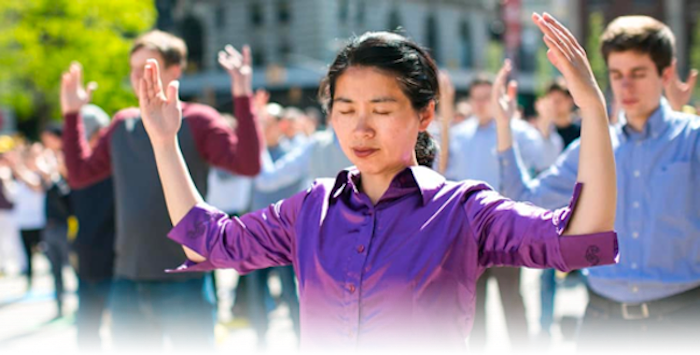
In my daily life, I do not do the Falun Dafa exercises every day. Therefore, when I participate in Marching Band activities, I feel especially grateful when encouraged by other practitioners to exercise together every morning. Staying with practitioners also makes it easier for me to get up early.
While exercising, I try to ensure that my movements meet the required standards, so from time to time I open my eyes to check my postures.
While doing the second exercise, as I held the wheel above my head with both hands, I felt that my hands were properly aligned and facing each other. However, when I opened my eyes to check, I realized that my right hand was higher than the left, and they were slightly staggered, one forward and one backward. After correcting my posture and closing my eyes again, I felt as if my hands were misaligned. It turned out that what I had felt to be correct was actually wrong.
We tend to think that we know our own body very well. But in fact, our perception of our own limbs can be significantly off. While doing the second exercise, I clearly saw how mistaken my own sense of alignment could be. This led me to reflect on other aspects of my life as well. When I believe I am definitely right and fully understand something, couldn’t I be making the same kind of mistake?
I realized that I should be more humble and often ask myself whether I might be doing something wrong. The process of correcting my posture during the exercises is, in fact, also a process of correcting my own understanding and improving myself.
Each time I did the exercises, I paid attention to following Master’s verbal instructions and making sure my movements met the requirements. While doing the third and fourth exercises, if my mind wandered even slightly, I immediately noticed that my movements became faster than Master Li directed. So I reminded myself to stay focused, listen carefully, and move only after hearing the instructions.
The fifth exercise is the most difficult. When I first began the sitting meditation, I could only sit in the single-lotus position for fifteen minutes. It took me more than ten years to reach one hour in the full-lotus position.
During that time, I sometimes wondered that perhaps I would never be able to meet the requirement of sitting in the full-lotus for one hour, that maybe my physical condition wasn’t suitable. I admired those practitioners who could sit in full lotus effortlessly for long periods of time.
Master said:
“The requirement is to achieve full-lotus ultimately. Practice it gradually, and everyone will be able to sit in full-lotus. In China elderly people over eighty years old have been able to gradually cross both legs, so there won’t be a problem. As long as you practice, you will gradually manage to cross them.” (Teachings at the Conference in Houston)
I told myself, “I should have faith in Master Li and the Fa, and not make excuses for myself. Just keep exercising and eliminating karma, and one day I will succeed.”
When studying the Fa, I tried to sit cross-legged as much as possible. In daily life, whenever there is an opportunity, I always try to sit in the lotus position. Sometimes, after a full day of activities, my legs were swollen and painful, and my whole body felt exhausted. I soon realized that sitting in meditation with crossed legs was a very effective way to restore my physical strength.
Soon after crossing my legs, the pain could be intense. But my experience was that although there was a sharp pain at the start, there was also a subtle sense of relaxation. If I persisted for a few minutes, the pain would ease quickly, and I would feel a wonderful sensation of energy flowing throughout my whole body. My strength and vitality would recover rapidly.
How long I could sit in the lotus position related to how much my xinxing improved. Just as Master said:
“Once you improve your xinxing, your body will undergo a great change. Upon xinxing improvement, the matter in your body is guaranteed to transform.” (Lecture One, Zhuan Falun)
Conflict Is an Opportunity to Look Inward
When practitioners are together, conflicts can arise, but they are also opportunities to improve my xinxing in cultivation.
During a Tian Guo Marching Band activity one year, I had such an experience. One evening in our hotel room, I commented to a practitioner about the qualities of all the hotels we had stayed in that year. I expressed strong dissatisfaction with a particular hotel in one city and insisted that the local practitioners must have been careless or lazy in arranging the accommodations.
That practitioner began to say that there might have been other reasons. However, I rudely interrupted her and persisted in blaming the local practitioners, convinced that their laziness was the only explanation. At the time, I didn’t realize that my criticism of others was actually a manifestation of my own attachment to comfort.
The next morning, while everyone was doing the exercises together, I came cross a practitioner from that city. I thought it would be a good opportunity to give him some feedback about the shortcomings of the hotel where we stayed.
However, he did not accept my suggestions after listening. Instead, he explained how difficult it had been to find a suitable hotel. He also pointed out that there were problems with my logic. I was momentarily stunned. I couldn’t understand what pointing out deficiencies of a hotel room had to do with logic. But I clearly felt that my heart had been stirred. Fortunately, the exercise music started at that moment, and we stopped our strained conversation.
While doing the exercises, I thought: we are all cultivators. When conflicts arise, I shouldn’t look for problems in others. Instead, I should examine myself to see where I may have gone wrong. Suddenly, I recalled that the practitioner had said my logic was flawed. Where exactly had I been illogical?
At that moment, a thought flashed through my mind: my premise was wrong. The night before, I had insisted that the local practitioners were lazy, and that this was why we had stayed at the same substandard hotel several times. That assumption itself was unfounded.
The practitioner I spoke with didn’t know about the previous conversation, but he pointed directly to the crux of my problem. Wasn’t this Master using his words to give me a hint? I realized that I shouldn’t have such negative thoughts and complaints. I shouldn’t treat practitioners this way, nor should I treat anyone or anything this way.
Everything that happens must have a reason. Cultivation is about finding our own attachments through the conflicts, eliminating them, changing our human notions, and elevating our level. It may have seemed like a small matter, yet it helped me find my attachment to comfort and complaint.
There are no small matters in cultivation. The Tian Guo Marching Band affords us with not only an opportunity to help Master Li save people through music, but also provides an environment in which we can cultivate and improve together.
I am deeply grateful for Master’s compassionate arrangements and for the support and help of other practitioners.
The above are just some of my personal cultivation experiences. If there is anything inappropriate, please point it out with compassion.
Thank you, Master! Thank you, fellow practitioners!
Copyright © 1999-2026 Minghui.org. All rights reserved.