


(Minghui.org) Mr. Liu Wansheng spent the last five months of his 6-year prison term in and out of the hospital. When his term ended on April 22, 2026, the prison guards sent him home from the hospital. He died one week later, at the age of 71.
 Mr. Liu in his younger years
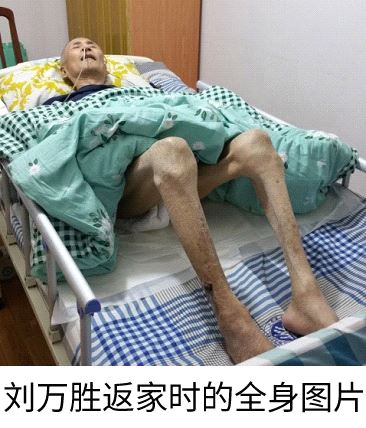 The day Mr. Liu was sent home
Mr. Liu’s prison sentence was due to his faith in Falun Gong, a mind-body practice that has been persecuted by the Chinese Communist Party since July 1999. The Jinzhou City, Heilongjiang Province resident served the majority of his term at the Jinzhou City Prison, which is notorious for torturing Falun Gong practitioners, especially after Shi Yuntao was appointed as warden in 2023.
Under Shi’s directive, deputy warden Zu Xingzhen promised promotion and cash rewards of up to 10,000-20,000 yuan if any guard managed to make a Falun Gong practitioner renounce his faith. Practitioners who held firm to their faith were denied all forms of communication with their families and only allowed 100 yuan per month to purchase daily necessities.
Many practitioners have been brutally tortured in the prison. Some died as a result. Prior to Mr. Liu’s passing, Mr. Zhao Jiyuan, 71, died on July 4, 2025, while serving a 7.5-year term; and Mr. Zhou Yonglin, 75, died on March 23, 2026, only 62 days after he finished serving a five-year term at the prison.
Minghui.org had previously reported on Mr. Liu’s arrest, torture, and passing. The rest of this article provides additional information about the last five months of his life.
No Patient Signature on Medical Records
Mr. Liu was arrested on April 23, 2020, and sentenced to six years and fined 10,000 yuan on September 30, 2020. He was taken to the Panjin Prison in March 2021 and later transferred to the Jinzhou Prison.
Due to the poor conditions and severe abuse in prison, his health gradually declined. He was hospitalized six times in his final five months of imprisonment. His family was never allowed to visit him in the hospital.
Of his six hospitalization records, only one had a prison guard’s signature, while the other five were blank in the signature field. By law, hospitals must obtain a signature from patients or their families before providing inpatient treatment.
If Mr. Liu was in a coma all the time, then his family should have been notified and given the chance to sign the paperwork. If he was conscious, then he might have refused to sign because the conditions stated on the records didn’t match his real health condition. His family never heard from him about what happened, as he remained in a coma after he was sent home on April 22, 2026.
“Cerebral Infarction”
Mr. Liu was first rushed to the Jinzhou City Central Hospital on November 23, 2025, after experiencing nausea and vomiting for one and a half hours. The medical records shown below indicated that he was brought into the emergency department at 7:45 p.m. that day.
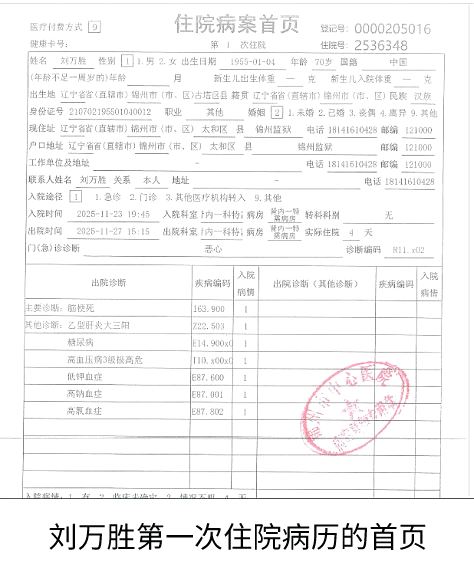 Mr. Liu’s discharge papers after he was first hospitalized on November 23, 2025
Mr. Liu was given a brain CT scan and diagnosed with cerebral infarction. The above medical records also stated that he had six other conditions, including hepatitis B, diabetes, severe high blood pressure, hypokalemia, hypernatremia, and hyperfluoridemia.
Mr. Liu was then admitted to impatient care. Strangely, they put him, a “stroke” patient, in the nephrology ward, not in the neurology department (as shown in the medical records). He was discharged at 3:15 p.m. on November 27, 2025, only to be rushed to the same hospital’s emergency room three hours later. He was returned to the prison late that night.
Mr. Liu was later hospitalized four more times, including once on December 12, 2025, after he fell into critical condition. His family suspected that the lack of timely medical care to treat whatever real medical conditions he had led to his continued deterioration over the next few months.
Mr. Liu was labeled as a stroke patient, yet during his five months of frequent hospitalization, he was only given one brain CT scan. No MRI's or other tests commonly used to monitor stroke patients were performed. On April 20, 2026, two days before his discharge, the doctors ordered a brain CT scan and an MRI. However, they canceled the tests one hour before his discharge without providing a reason.
Sudden Coma?
The discharge paper from Mr. Liu’s sixth hospitalization indicated that he was still “conscious” at the time of his discharge on April 22, 2026.
Mr. Liu, however, was unconscious when the prison guards sent him home from the hospital. His family questioned how a conscious person could suddenly fall into a coma during the ten-minute or so drive from the hospital to their home.
The prison guards claimed it was because he was still suffering from stroke complications. His family noted that in his final eight days of life, he did not exhibit any symptoms of a stroke, such as hemiplegia or facial paralysis. Yet he remained in a coma since he was sent home. They doubted that “stroke” was the reason he was unconscious as the prison had claimed.
Diabetic Foot?
Mr. Liu’s family noted that his wrists and ankles each had fresh wounds. They suspected that he was handcuffed and shackled throughout his hospitalizations.
The prison guards didn’t explain Mr. Liu’s wrist injuries, but claimed that the ones on his ankles were because of his “diabetic foot.”
Mr. Liu was indeed found to have diabetes during his first hospitalization. But his medical records indicated that his blood sugar was later under control with an A1C (a glycated hemoglobin test) reading of 9.1%. While that was higher than a normal range of 5.7%, it would not have caused festering in his ankles.
Usually diabetic foot takes time to develop. Nowhere in his first three hospitalization records did it mention any skin conditions. The fourth hospitalization records stated, “Two months ago, without any obvious cause, the patient experienced limb weakness, and skin ulceration and suppuration were visible on the lower limbs.”
Mr. Liu’s family questioned why the hospital failed to record such skin conditions in his first three hospitalization records. It could either be medical malpractice on the part of the hospital or they were being pressured by the prison to cover up his condition.
Additionally, diabetic foot commonly occurs at the distal end of the ankle, but Mr. Liu’s were located above the ankles and were symmetrical on both sides (see the photos below). These locations were precisely where shackles would be placed.
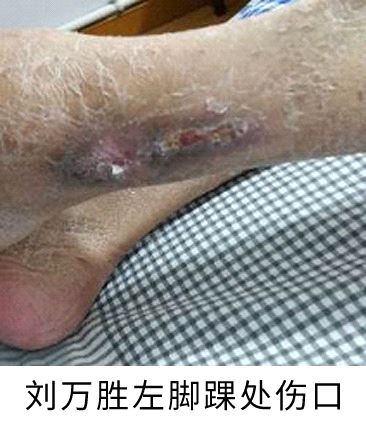 Injuries on Mr. Liu’s left ankle
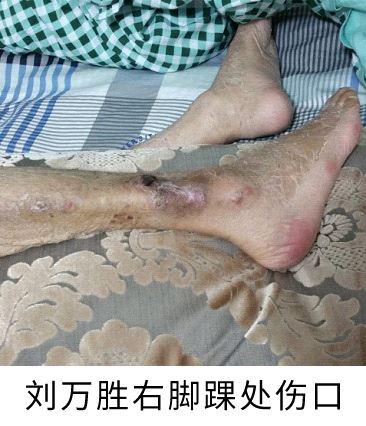 Injuries on Mr. Liu’s right ankle
While the medical records didn’t mention anything about his wrists, Mr. Liu’s family spotted bright red wounds there, seemingly caused by long-term wear and tear from the handcuffs.
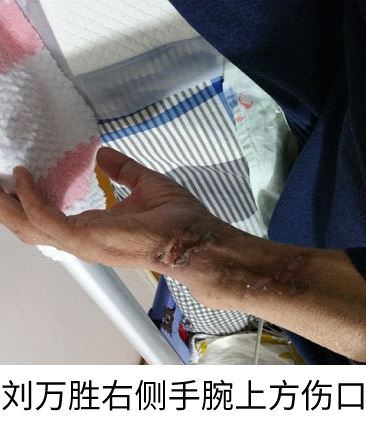 Injuries on Mr. Liu’s right wrist
The wounds on Mr. Liu’s ankles and wrists were large, deep, and fresh. His family suspects that he likely struggled frequently and the handcuffs and shackles cut deeply into his flesh.
Mr. Liu, however, did not have bedsores on his lower back, hips, and other areas of his torso prone to friction. His medical records indicated that he experienced no paralysis, but the nursing records showed that he was bedridden. His family suspects that while he was handcuffed and shackled, he was still able to able to move and tilt to his side from time to time. This may help explain why he had no bedsores despite being confined to bed for so long.
Related Reports:
After Seven Arrests and Three-year Labor Camp Terms, Liaoning Man Imprisoned Again for His Faith
Liaoning Man Sentenced for His Faith Despite Call for Release from His Son and Now Deceased Father
Copyright © 1999-2026 Minghui.org. All rights reserved.